Stefano Peyrani
Not all wines ask to be explained. Some simply need to be encountered, at the right moment.
Stefano Peyrani and the Long Time of Barbera.
Arriving in the Asti Monferrato means slowing down without even noticing. The road narrows, the color of the soil turns to ochre, and the hills seem to rest against one another like the pages of an ancient book. Here, in a 19th-century house that still preserves the memory of those who once lived in it, Stefano Peyrani welcomes us.

Stefano speaks like someone who has lived fully and has nothing to prove. His way of telling the story of wine recalls that of Alessandro Barbero: only apparently digressive, deeply historical, always rooted in context. Every sentence opens a parenthesis, every parenthesis refers back to a specific time, to a choice made or a necessary renunciation. Nothing is accidental — not even the silence.
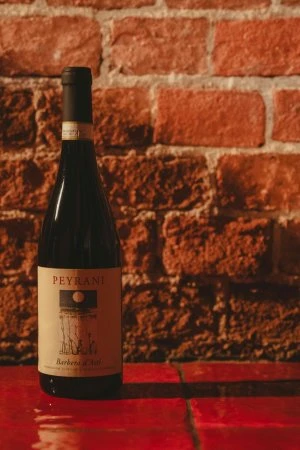
Barbera d'Asti Bric Piovà is the remarkable red wine by Stefano Peyrani that you received through your subscription. Discover it.


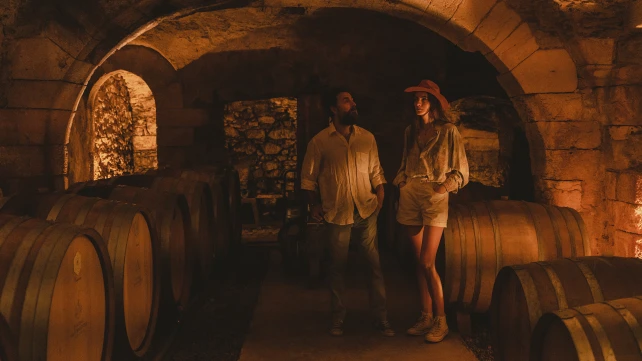
The winery is essential, almost austere. On the ground floor, stainless steel — orderly, functional; below, in the underground cellar, the wood of the tonneaux, kept in silence and darkness.
Here, the idea of “enhancement” does not pass through aesthetics, but through respect.
Production is not consistent: there are vintages that simply do not exist. “I didn’t produce,” Stefano says, as if it were the most natural thing in the world. And it is, when the vineyard is truly in command.
The soils are an open-air geological map. Ochre, clay, sand, marine fossils. “Piedmont’s fortune is that these are marine-origin soils” he explains as we walk among recently Guyot-pruned vines. On one side, completely calcareous, white soil. On the other, hills of oceanic origin. Here, only Barbera. Just over four-tenths of a hectare. Everything else has been thought through, reconsidered, replanted.
Become an Explorer
Every month we will present an unknown and exclusive winery we have discovered. Every month you will receive what we consider to be its best bottle delivered directly to your door: a wine that is always new, exclusive and surprising.


It is precisely while walking between the rows that Stefano gives himself over to memory. The Monferrato he describes is one of the few who remained. Until the First World War, it was all vineyards here. Then came industry, factories, Turin just forty minutes away. “There are only a handful of us left,” he says almost under his breath. But those few kept the thread with the land alive. Stefano says this thinking of his grandfather, who, despite living in Turin, always returned here — with constancy and affection — so as not to lose that deep bond with the hills and with childhood. A simple gesture, repeated over time, that today gives meaning to everything else.


For years, Stefano kept old vines alive, with ridiculously low yields.
“They say that to achieve quality you need around 60 quintals per hectare. We were producing 15.”
An economic madness, but a very clear statement of intent. When it was no longer sustainable, he chose to study, to plant new clones, seeking only one thing: wines meant for aging. Intervention in the vineyard is minimal, not certified, but deeply conscious.
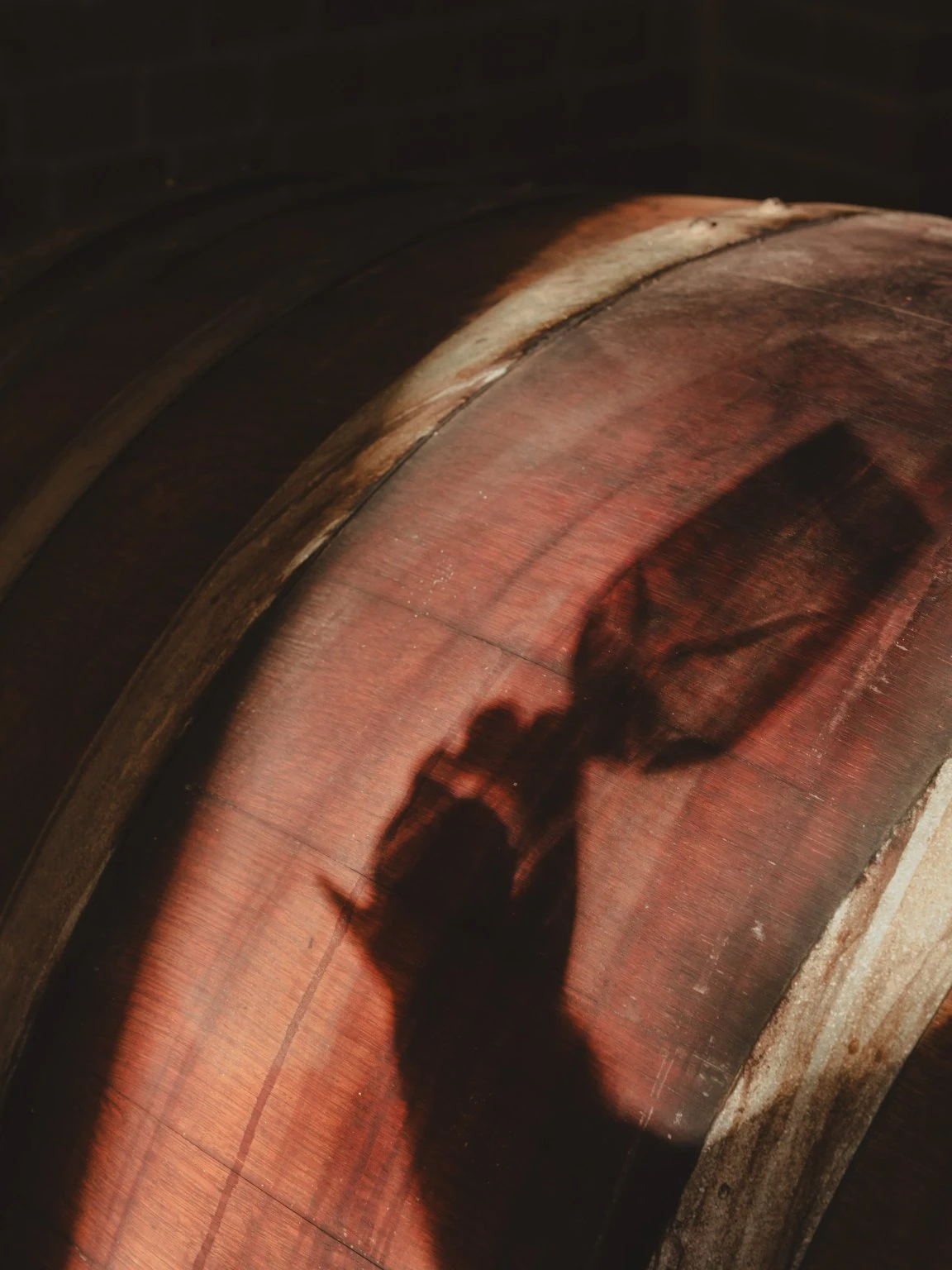
Descending into the historic cellar, the change in temperature is immediate. The 19th-century walls transform the space into a natural refrigerator. The scent of the tonneaux greets us at once. The herringbone floor, the word Vitis dominating the room — a silent homage to the vine to which everything is owed. Where once there were enormous casks, today there are hidden tonneaux, all used, never new. Medium toast. Long time.


Alcoholic fermentation, then malolactic fermentation, and then years. Two in stainless steel, six in wood. Sometimes more. “If you leave it too long in steel, it closes the wine.” Nothing here is bottled in haste. Topping up the thirteen tonneaux requires about fifteen liters per month. His entire investment is right there, locked away in the cellar.
We first taste a 2016, drawn directly from the tonneau with a wine thief. It is a necessary tasting, almost didactic: it serves to understand how, for Stefano, aging is not an option but an essential condition.
In the glass there is energy, substance — a Barbera still in tension, clearly expressing the starting point of his work.
It allows us to measure the distance, to prepare both palate and mind for what comes next.


Stefano’s dedication and his sincere curiosity about our reaction lead him to go further. From the only remaining tonneau, he lets us taste the 2009 as well. The finish is surprising: balsamic notes, leather, chocolate, and a freshness you would not expect after so many years. “The nicest compliment I ever received came from a Frenchman from Châteauneuf-du-Pape: he told me it reminded him of a great Châteauneuf.” Stefano recounts this without emphasis. Here, compliments do not make noise.


With the 2011, time shifts its rhythm. We move outside into the light of the sunset. It is the right moment, when the wine can finally speak without interference. This Barbera d’Asti comes from the parcel in Piovà Massaia, about thirty minutes from where we are now — not from these Ravizza vineyards we see before us.
Piovà Massaia was once church land, silent and extraordinary plots. Stefano acquired them and accompanied them through time, restoring their voice and dignity: a patient gesture, made more of waiting than of intervention.


Here in Ravizza, by contrast, only in recent years has he decided to replant Barbera, replacing vines that had become exhausted, dating back to his grandfather’s time. Back then, the vineyard produced little — but enough to deserve being listened to all the way through.
In the glass, the 2011 Barbera d’Asti is deep, composed, incredibly alive. Ten years in tonneaux have sculpted the wine without weighing it down, yielding a Barbera of rare elegance, capable of combining maturity and freshness with disarming naturalness. It is here that Stefano’s vision becomes fully clear: a wine that does not chase time, but moves through it with grace.
The labels bear the signature of Tino Aime, a Piedmontese painter and dear friend. Engravings that live on each bottle like a permanent memory. “Mine are powerful wines,” Stefano says. Powerful not for extraction, but for their endurance over time.

Stefano shares his most difficult memory quietly, almost with modesty. It was the period when he went door to door to sell his wine. Once, a lady — without even tasting it — looked at the vintage on the label and simply said, “But this wine is old.” There was no malice, only distance. It was at that moment that Stefano understood he could not continue like that.
“Not all wines ask to be explained. Some simply need to be encountered, at the right moment.”


Tasting Stefano Peyrani’s 2011 Barbera d’Asti means entering a different sense of time, shaped by slow choices, conscious waiting, and a vision that allows no shortcuts. It is a wine that does not seek immediate approval, but rewards those who devote attention to it.
And that is precisely why it becomes part of La Versione di Gunter: because we believe in wines that know how to wait, in stories that deserve trust, and in producers who put everything they have into a bottle.
Here, it is not only about drinking well, but about choosing with whom to do so.
Subscribe
Every month we will present an unknown and exclusive winery we have discovered.
Every month you will receive what we consider to be its best bottle delivered directly to your door: a wine that is always new, exclusive and surprising.
If you choose an annual subscription and pay in a single instalment, you will receive a 10% discount.
Gunter's other travels
Provence
Château Romanin
We have a profound respect for the land and employ fully biodynamic practices: an art that harnesses the life forces of nature to create exceptional products.
Provence
Château Des Bormettes
85-90% of our production is focused on rosé: here in Provence, we are very fond of pale wines.